doula supportwhat is a doulacanadafamilies
What is a doula? A guide for families in Canada
Understand doula support in Canada, the practical arrangements to check and the local questions to ask about paying for care.

The question “Do we need a doula?” is easier to answer when you start with your own circumstances. Who will be around during labour? What happens if you travel away from home to give birth? Who could help during the first days back? A doula may fill a gap in that picture, but the useful starting point is the support you want.
A doula offers non-clinical support around pregnancy, birth or the postpartum period. Canada's national maternity guidelines discuss doulas as part of labour support, alongside the distinct work of healthcare professionals. The title does not tell you exactly what an individual service includes.
What would you actually book?
A birth doula arrangement might include preparation meetings, availability around your due date, attendance during labour and follow-up. Postpartum support is a separate conversation about help after birth. Some practitioners offer both; ask them to describe the specific work, hours and limits.
An example makes this easier: “My partner returns to work after a week, and I am worried about managing mornings.” Ask what the doula could offer in that situation. You may need help on particular days rather than the largest package on a website.
Before birth, a meeting could help you work through how you want people to communicate, who you would like involved and which questions to take to your maternity provider. You do not need to arrive with a finished plan. Ask whether meetings can include your chosen supporter and whether they take place in person or online.
Keep the roles clear
Your doula arrangement should distinguish non-clinical support from the care provided by your midwife, physician and other healthcare professionals. A reassuring conversation does not replace an assessment. Take medical questions to the relevant clinician, including questions about changes in your health or your baby's health.
Ask a doula how they would help you ask questions and communicate preferences. You are looking for support that leaves space for your decisions. If a practitioner also holds a healthcare qualification, establish which role they are providing under your agreement.
You can want doula support while planning pain relief, a caesarean birth or a hospital birth. Discuss what the service would look like in your situation and what happens if it changes. Confirm who may accompany you in different areas directly with your birth facility.
Build around your people, language and community
The people you choose may include a partner, relatives, friends or others important to you. Canada's family-centred pregnancy guidance recognises a range of chosen supporters. A useful planning conversation begins with your definition of family.
If language, cultural practices, disability access or previous experiences affect the support you want, ask concrete questions. For example: “How would you help us make room for this practice?” or “How can we arrange conversations in a format I can use?” You decide how much personal history to share at an introductory meeting.
For First Nations, Inuit and Métis families, ask relevant local or community-led services what support is available and who it is designed for. Do not assume every programme has the same eligibility or approach. You can ask a prospective practitioner about their relationships, experience and the limits of their knowledge.
If birth involves travel, plan both locations
If you expect to give birth away from home, ask where the doula can actually support you. Does their availability cover the place you will stay before birth, the birth facility and your home afterwards? What happens if you relocate earlier than expected?
Write down travel charges, accommodation arrangements if relevant and who provides backup in each location. Separate remote support from in-person attendance. Ask who will help you reconnect with local services when you return home; do not assume a practitioner can follow you across a large service area.
Check payment and programme eligibility locally
Ask the provincial or territorial service, insurer, employer benefit or community programme you hope to use whether it covers the proposed doula service. Get the eligibility, practitioner requirements and payment process before relying on reimbursement. Coverage for another maternity service does not answer those questions.
British Columbia example: the First Nations Health Authority links families to the Doulas for Aboriginal Families Grant. Check the programme's current criteria and availability directly. This is a specific support route, not a Canada-wide entitlement to doula funding.
For private bookings, confirm the total in Canadian dollars, any applicable taxes, travel costs, payment dates and terms if either party cannot proceed. A payment schedule should be clear enough to compare with your other commitments.
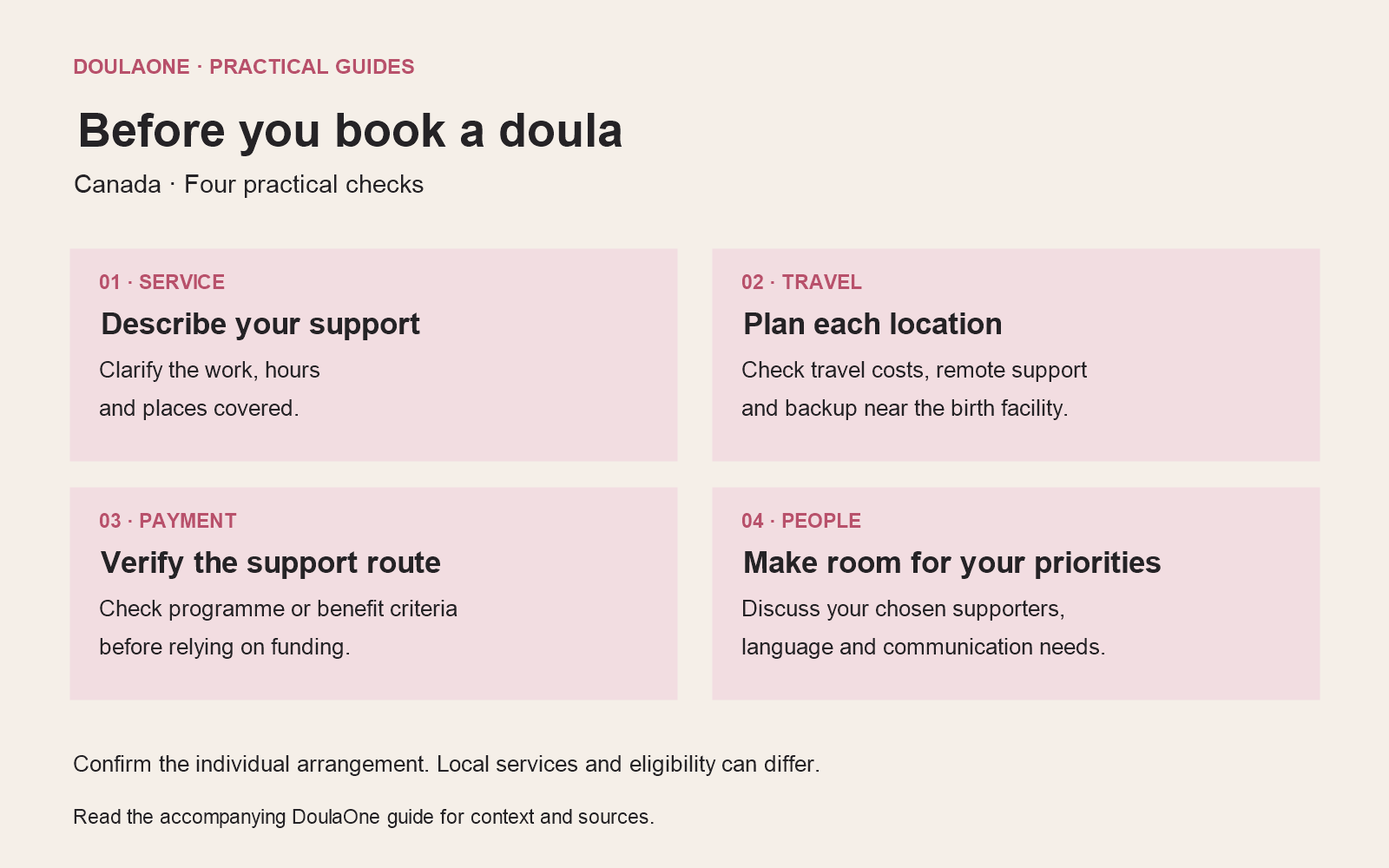
Choose the arrangement, as well as the person
Ask about training, experience relevant to your situation, ongoing learning and how the doula obtains support in their work. Request the agreement and ask how concerns, privacy and information-sharing with backup practitioners are handled.
After the conversation, identify what is confirmed and what remains uncertain. Feeling heard matters, and so do the details. You can take time, ask another question and compare options without promising a booking.
The right next step may be a doula enquiry, a conversation with your maternity provider or a call to a community service. Start with the gap you want to fill and find out which support can realistically meet it.