birth preferencesbirth planninginformed choicespregnancy
How to write birth preferences that put your voice first
You do not need to predict your birth or produce a perfect page. Use these prompts to explain what matters, ask questions and discuss your choices with your maternity team.

You sit down to write a birth plan and suddenly there are decisions everywhere: the room, the people, pain relief, the first feed. A blank document can make it feel as though you are supposed to know exactly how birth will unfold.
You are allowed to be unsure. You are also allowed to care deeply about particular things.
Birth preferences give you somewhere to explain what matters to you and open a conversation with your maternity team. They can be a few sentences, a form or a longer document. You do not have to earn respectful care by producing the perfect page.
Start with the experience you want support with
Before working through a checklist, try three questions:
What helps me feel heard when I am making a decision?
What would I like the people supporting me to understand?
What am I worried about or still unsure of?
Your answers may concern communication more than equipment. Perhaps you need time to process spoken information, want an interpreter arranged, or find unexpected touch difficult. You might want someone to explain what is happening before an examination. You do not have to describe a distressing experience in detail to explain a support need.
For example: “Please introduce yourself and tell me what you are suggesting before touching me. I find it easier to follow information when one person speaks at a time.”
This is your document. Use the words you would naturally say, rather than language that sounds appropriately medical.
Use a checklist to find your questions
The NHS birth-plan checklist covers subjects including where you hope to give birth, who you want with you, movement, equipment, pain relief, skin-to-skin contact and feeding. Use those topics to notice what you want to discuss with your midwife.
You do not need to tick a preference in every category. “I would like to talk this through” is useful information too. If a choice depends on facilities or your individual circumstances, write the question beside it rather than trying to settle it through an online template.
For each subject, separate a preference from a question. For instance: “I would like to use water during labour if available. What could affect that option at my planned place of birth?” Your midwife can explain the local arrangements and relevant clinical considerations.
Keep consent separate from the plan
A birth plan helps communicate your wishes. It does not provide blanket permission for future examinations or treatment.
The NHS explains that consent must be voluntary and informed, with the capacity to make the decision. An adult who can make that decision can agree to or refuse treatment, and can withdraw consent. Read its consent guidance and discuss questions with your care team.
You can include a sentence such as: “Please explain what you recommend and ask for my consent at the time.” You can also change a preference. Asking for pain relief that you had hoped not to use does not invalidate the rest of your document or say anything about your strength.
Naming a birth partner or doula tells the team who you want supporting you. It does not, by itself, give that person legal authority to make treatment decisions for you. If decision-making capacity or legal representation is a particular concern, ask for individual advice: the legal frameworks differ across UK nations.
Choose a format that is easy for you to use
A short front page can make key information easy to find. That is an option, not a rule that every family must follow. If you need more space for accessibility needs, previous experiences or specialist advice, use it.
Our suggested front page has four sections:
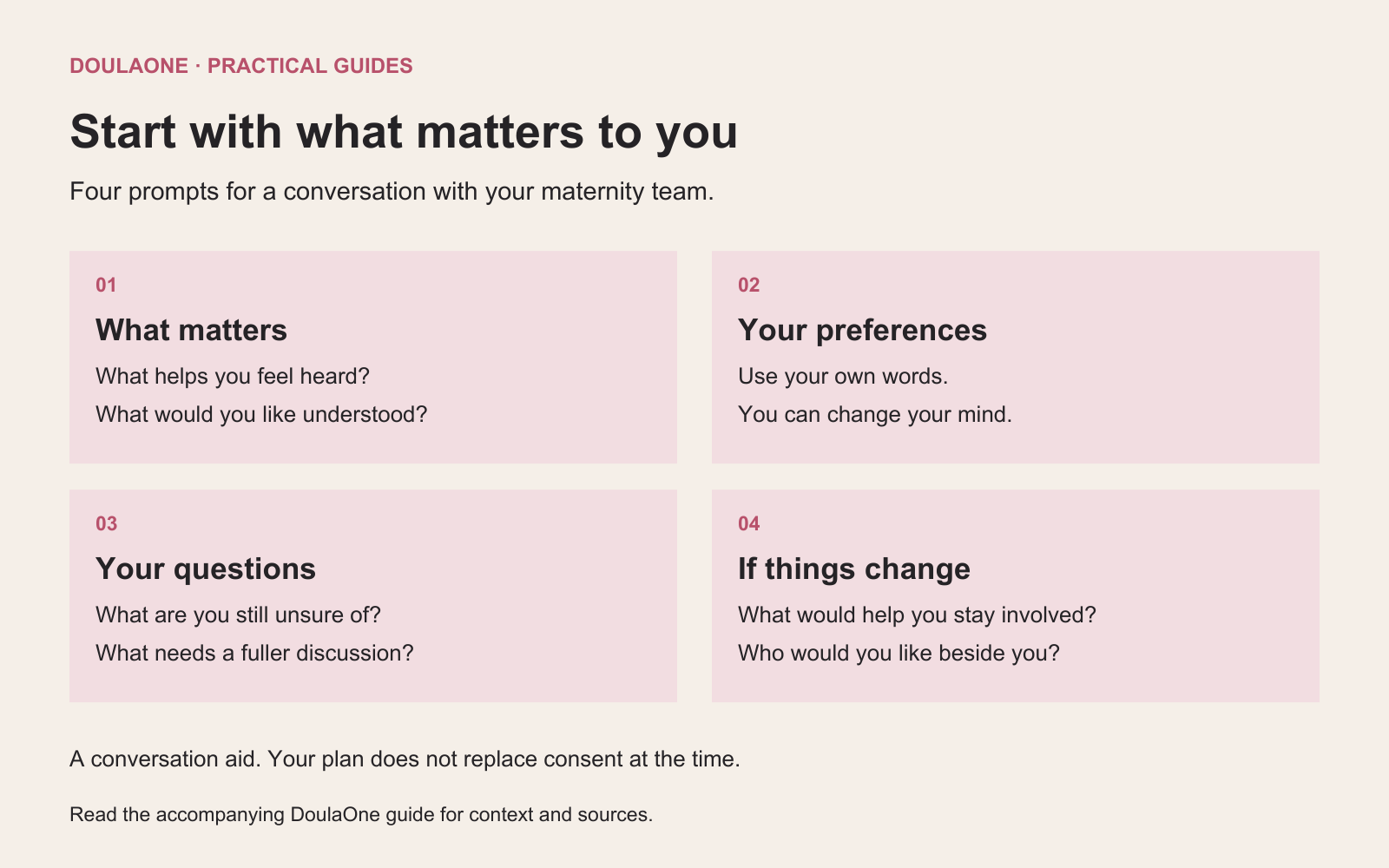
What matters most to me
Choose the points you most want someone meeting you for the first time to understand. This might be who you want present, how you prefer information, or a concern you have already discussed with the team.
My current preferences
Use short statements. You can add detail underneath if needed. Leave out other people's opinions unless you want them there.
Questions for my maternity team
Keep unresolved questions visible. A plan that says “I need more information about this” is doing useful work.
If circumstances change
Write down what would help you stay involved: explanations, time for questions where possible, or a particular person beside you. Discuss practical possibilities with your team beforehand.
Some wording you can adapt
These are writing prompts, not a recommended set of clinical choices:
Communication: Please speak to me directly, even when my birth partner is answering practical questions. I may need a moment to take in information before I respond.
Support: I would like my chosen companion involved in conversations with my agreement. Please check with me about anyone else being present.
Decisions: If you recommend a change, please explain why, the options and how urgent the decision is. I would like to ask questions where time allows.
Comfort: I would like to discuss the pain-relief options available where I plan to give birth. I may change my mind during labour.
After the birth: I would like to discuss my preferences for early contact with my baby and feeding support, including what may be possible if either of us needs additional care.
Delete anything that does not sound like you. Add a date so you and your team can recognise the latest version.
Talk it through before you need it
Take your preferences to an antenatal appointment. If there is a concern that needs more time, ask how to arrange a fuller discussion. You might want to talk through a planned caesarean, an induction recommendation, a previous difficult birth or an accessibility requirement.
An appointment can turn a vague concern into a specific question: “Who can help me discuss this?” or “How will this information be available to the team caring for me?” Ask where the plan should be kept in your local maternity record and whether a paper copy would help.
Share your latest version with the people you have chosen to support you. Instead of asking them to enforce a script, tell them what helpful support looks like: reminding you of a question, asking for an explanation, or making sure someone hears what you have said.
A change of plan is not a personal failure
You can prepare carefully and still encounter something unexpected. Afterwards, you may feel content, relieved, disappointed, upset or several things at once. The existence of a written plan does not make you responsible for how events unfolded.
Keep space for both practical preparation and uncertainty. A useful final question is: “If something changes, what would help me feel informed and supported?”
If you would like non-clinical help thinking through those conversations, you can explore DoulaOne as a starting point for finding doula support. Your maternity team remains the right place for advice about your individual clinical options.
UK-focused guide. Sources checked 27 September 2026. Local services and legal arrangements differ; discuss your circumstances with your maternity team.