doula basicsbirth supportpostnatal supportchoosing a doulauk
What does a doula do? Birth and postnatal support explained
Understand birth and postnatal doula support, how it fits alongside your maternity care and chosen supporters, and what to check before booking.

You may already have a midwife, a partner and people offering to help. So where does a doula fit? The useful question is what support you would like more of: someone to talk things through with, a familiar presence during labour, or practical help once you are home with your baby.
A doula offers non-medical emotional, practical and informational support. The arrangement can cover pregnancy and birth, the weeks after birth, or both. Doula UK describes these different roles, but individual services vary. Before booking, ask what a particular doula offers and what is included in the fee.
What support can look like before birth
An antenatal meeting gives you time to explain what matters to you. You might want to discuss who will be with you, how you prefer people to communicate, or questions you want to take to your maternity team. You do not need to arrive with a finished birth plan or a particular philosophy about birth.
For example, you might say: “I find it difficult to take in information when several people speak at once.” A useful conversation could turn that into a practical preference: one person explaining at a time, a written note of questions, and your chosen supporter helping you ask for clarification.
A doula can help you prepare that conversation. Your clinician remains the person to explain your individual medical situation, options and recommendations. If you need interpreting or communication support, ask your maternity service about suitable arrangements; do not assume the doula can take on that role.
Visits may be in person or online. Ask about their number, length and purpose, who can attend and what happens if an appointment needs to move. There is no single visit schedule that every family must follow.
During labour and birth
Birth support might include reassurance, helping you communicate your preferences, offering comfort measures you want, and helping your chosen birth partner take a break. What feels supportive is personal. You may welcome conversation at one point and want quiet later.
Agree how the doula joins you, the dates they are available, travel arrangements and backup if they cannot attend. Ask what support is possible if your place or mode of birth changes. Hospital arrangements may affect who can be present in different areas, so check directly with your maternity service rather than relying on a general promise.
Hiring a doula does not commit you to an unmedicated birth, a home birth or a particular feeding decision. You should be able to change your mind without feeling you have disappointed someone you hired to support you.
What happens after the baby arrives?
A postnatal doula's work depends on the agreed service. Ask about practical help, time to talk, support while you rest, and the specific baby-care or feeding support they are competent to offer. Make the tasks concrete: what would actually happen during a visit to your home?
Think about the gap you want help with. Perhaps relatives are available at weekends but weekdays feel daunting. Perhaps meals are covered, while you would value an unhurried conversation and help organising other support. A description of your day is more useful than expecting a standard package to fit automatically.
Check visit lengths, minimum bookings, overnight arrangements if offered, travel charges and rescheduling. Do not assume a postnatal visit included in a birth package is the same service as several weeks of separately booked support.
If you want specialist feeding or mental-health support, ask about the practitioner's relevant qualifications and referral arrangements. Doula support does not replace assessment or treatment from an appropriately qualified health professional.
How is a doula different from a midwife or birth partner?
A doula is a non-clinical supporter. That role does not include examinations, monitoring your baby's wellbeing, diagnosing a problem or providing midwifery care. NHS guidance explicitly distinguishes the role of birth companions, including doulas, from midwifery and medical care. This source is a regional NHS England guideline; ask your own maternity team about your care arrangements wherever you live in the UK.
Your chosen birth partner may be a romantic partner, friend, relative or another person you trust. You can discuss how their support and the doula's support fit together. You can also hire a doula when you are parenting on your own. Nobody needs to earn their place by performing a fixed set of tasks.
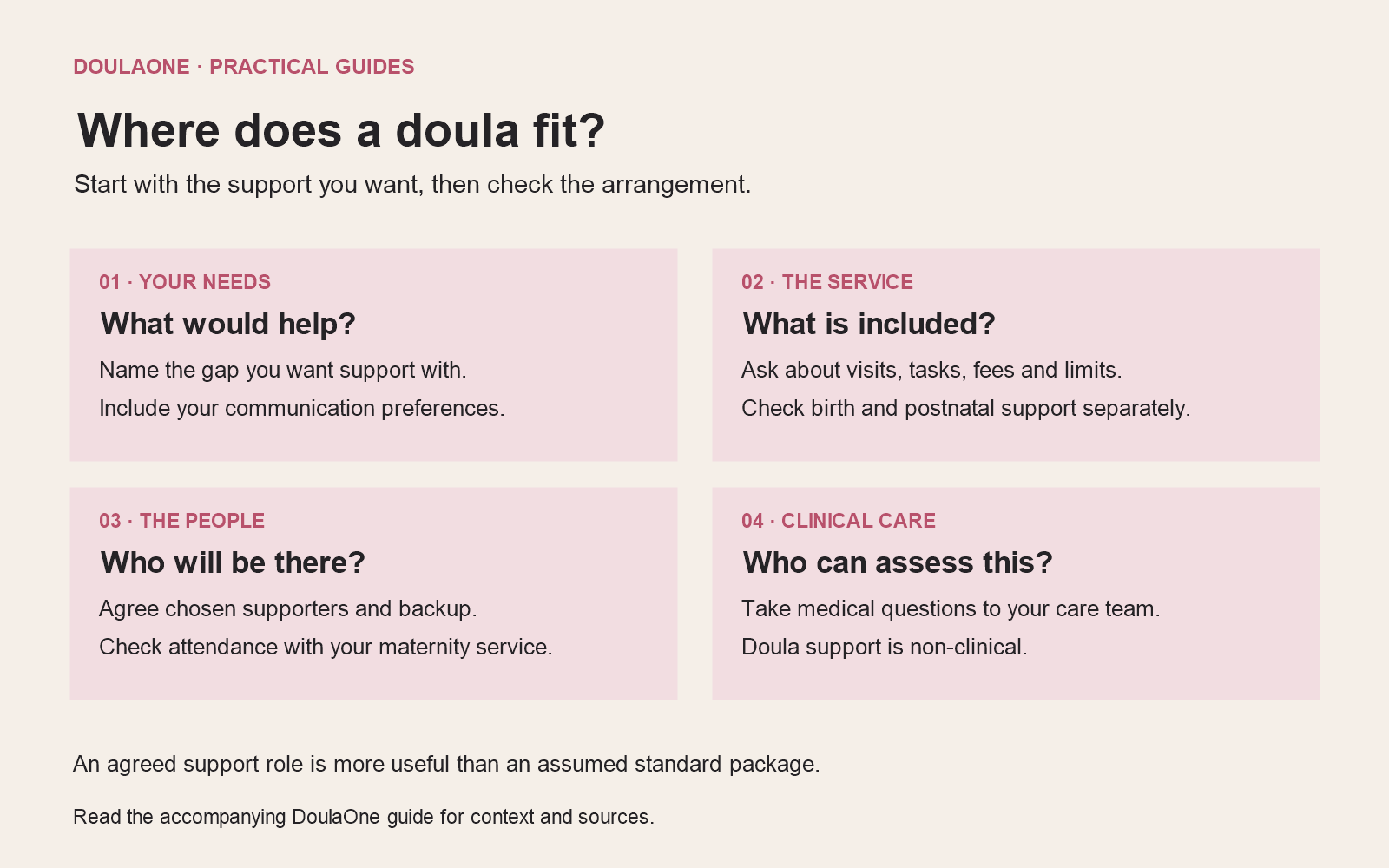
If a doula also holds a healthcare qualification, ask which role they are providing under your agreement. The title on a profile is not enough to establish what clinical care, if any, they are engaged to provide.
What does the research tell us?
A Cochrane review published in 2017 analysed data from 26 studies involving more than 15,000 women. Continuous support during labour may improve several outcomes, including satisfaction with the birth experience, and may reduce caesarean births. The review rated the overall evidence as low quality because of study limitations and differences between studies.
The supporters included hospital staff, people in a doula role and companions from participants' own networks. The results therefore do not promise what hiring one particular doula will do for your birth. They also do not mean an intervention is a personal failure. Consider research alongside your circumstances, clinical advice and the kind of support you value.
What should you check before booking?
Ask about training, relevant experience, ongoing learning and how the practitioner gets support with their work. Membership of an organisation can be a useful starting point for questions; check what that membership actually involves. Avoid judging competence solely by a polished website or assuming every doula has followed the same training route.
Discuss availability, backup, insurance relevant to the service, fees, cancellation arrangements and how concerns are handled. Request the agreement in a format you can comfortably read. Ask how your personal information is used and who may receive it.
A specific question often gives you more to work with than “What is your approach?” Try: “If I change my mind about something in my birth preferences, how would you support me?” Or: “What happens if you are already supporting another family when I need you?”
You can take time to consider the answers. A doula may be one useful part of your support, but hiring one is not a requirement for being prepared or a guarantee of a particular experience.
When you are ready, use DoulaOne to explore birth-worker profiles, then ask the individual practitioner about the support, availability and costs that matter to you.