doula supportwhat is a doulaaustraliafamilies
What is a doula? A guide for families in Australia
Understand doula support in Australia, the practical arrangements to check and the local questions to ask about paying for care.

You may have chosen a maternity service and still be working out who will support you personally. Someone to talk with before appointments, a familiar person beside you during labour, or practical help at home after birth can be different needs. A doula may offer some of that support. The important question is what you would actually be booking.
A doula is a non-medical supporter. Australia's Pregnancy, Birth and Baby explains the role: emotional and physical support around birth, with some practitioners also offering help after the baby arrives. Medical advice belongs with your doctor or midwife.
Begin with an ordinary situation
Instead of choosing a package by its name, describe what you want help with. You might say: “I lose track of my questions in appointments,” “My partner is anxious about labour,” or “We do not have family nearby after the birth.” Ask the doula what they could offer for that situation and what would sit outside their role.
A preparation meeting can be a place to discuss communication, the people you want involved and how you prefer to receive support. You do not need a completed birth plan or a commitment to a particular kind of birth. Ask whether meetings can include your partner or another chosen person, and how long they last.
In a birth-support booking, make the practical arrangement explicit. When would you contact the doula? Where would they meet you? What happens if the agreed dates or birth setting change? Warmth during an introductory call is valuable, but it should lead to clear answers.
A doula and a midwife have different roles
Pregnancy, Birth and Baby distinguishes doulas from registered midwives. It also notes that the Australian doula industry is unregulated and no specific doula qualification is required. Many practitioners undertake training; ask what the individual has completed and what it prepared them to do. A certificate should prompt questions about its meaning, rather than end them.
Take clinical questions to your maternity team. If someone advertises both doula work and a healthcare qualification, ask which role the agreement covers. Keep clinical contact details separate from the doula's availability arrangements.
You can ask how support would work alongside an epidural, a planned caesarean or an unexpected change of plan. Nobody you hire should make you feel that changing your preferences is a failure. Discuss the support you would find useful, including when you might want quiet or space.
Fit the booking to your maternity service
Whether your planned care is through a public hospital, private obstetric service, birth centre or another arrangement, ask that service about support-person access. Check the places where rules could differ, such as an operating theatre or recovery area. Avoid treating one practitioner's previous experience as a guarantee of access on your day.
If you live some distance from the birth facility, discuss the practical geography. Where would a preparation visit happen? Would the doula travel, and what would that cost? Who would provide backup nearby? If you are offered virtual support, establish which parts are remote and which involve someone being physically present.
These questions also help when you are comparing a solo practitioner with a team. Ask who you are likely to meet beforehand, who may attend and how everyone would learn your preferences.
Postnatal support needs its own description
Picture a day at home after birth. Which parts would you like help with? Perhaps there are visitors but little opportunity to rest. Perhaps practical tasks are covered, but you would value an unhurried conversation. Explain the gap, then ask what a visit could include.
Confirm hours, tasks, minimum bookings, rescheduling and any overnight service offered. Ask about relevant training if you want particular feeding or baby-care support, and how the practitioner would help you find specialist care when needed. A single follow-up included in a birth package may differ substantially from regular postnatal visits.
Ask about fees before assuming a benefit applies
Request an itemised quote in Australian dollars, including any applicable GST, travel, parking and additional hours. If you hope to claim through a benefit or insurer, confirm the specific service and provider directly before booking. The fact that a practitioner works around pregnancy does not establish that a payment will be reimbursed.
Pregnancy, Birth and Baby describes doulas as charging private fees and advises checking maternity-related cover. Do not treat a private doula quote as confirmation of Medicare or private-health-insurance eligibility. Ask what you would owe, when it is payable and what happens if support cannot be delivered.
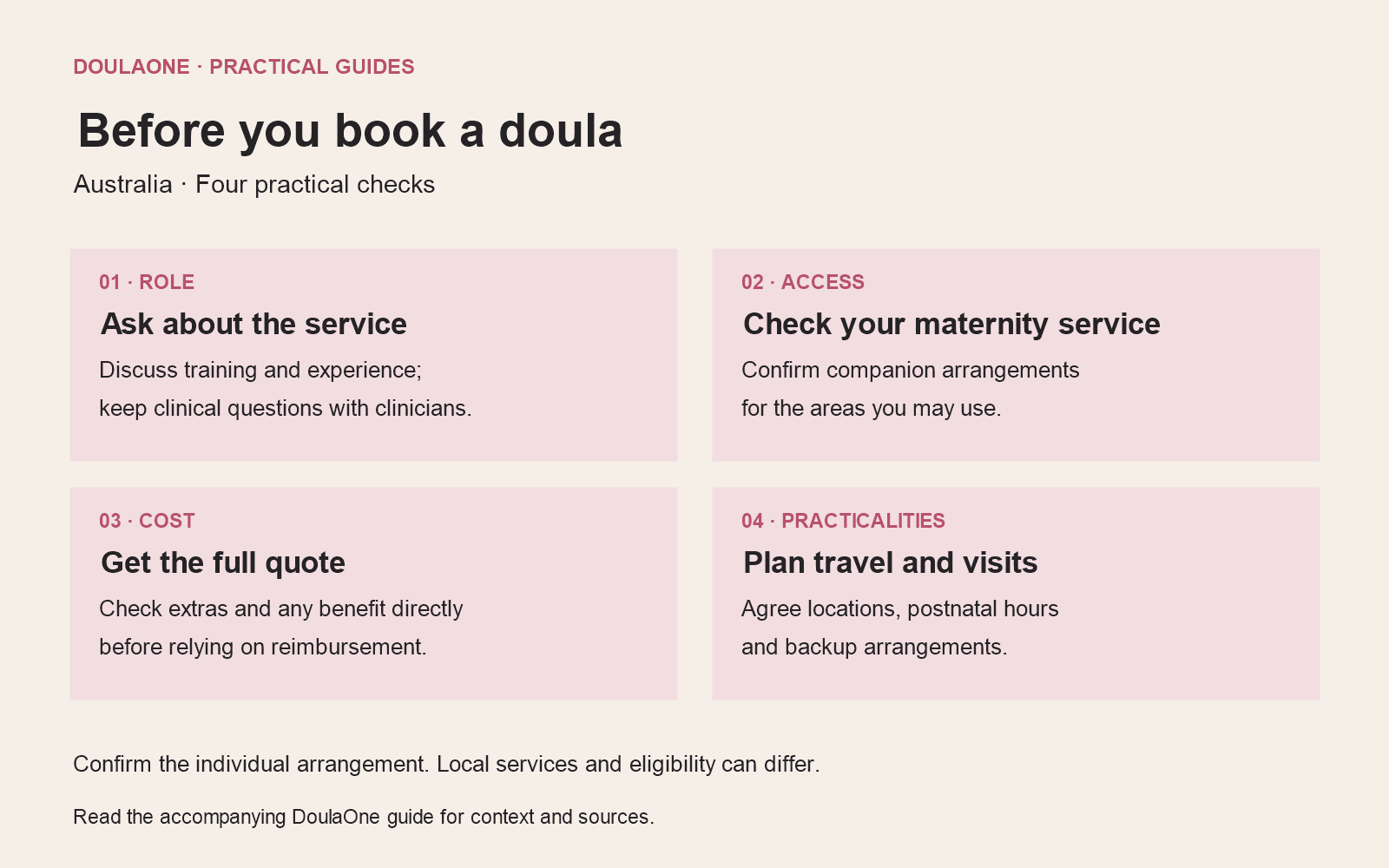
What a useful first conversation leaves you with
Ask about relevant experience, insurance, backup, written terms, privacy and the way concerns are handled. You can discuss cultural understanding, language or access needs without having to disclose every detail of your history before deciding whether to continue.
Afterwards, write down what is confirmed and what you still need to know. Could you ask for a change? Did the explanation match the support you want? Is the proposed service clear enough to compare with another option?
A doula is an optional part of your support, not a requirement for a good birth. Choose an arrangement that makes sense for your circumstances and leaves your decisions with you.