doula supportwhat is a doulausafamilies
What is a doula? A guide for families in the USA
Understand doula support in USA, the practical arrangements to check and the local questions to ask about paying for care.

You can have an obstetrician or midwife, people who care about you and a birth plan, and still want someone whose job is to stay focused on your support. That is where a doula may fit. Before comparing packages, it helps to separate three questions: what support you want, who provides your medical care and how the support will be paid for.
A doula provides nonmedical emotional, practical and informational support around pregnancy and birth. Some focus on birth attendance; others offer postpartum support, or both. The Kansas Department of Health and Environment explains the nonmedical role. The service you book still depends on the individual agreement.
Start with the gap you want help filling
“We would like more support” is a perfectly good starting point. Make it more useful by describing a situation. Perhaps you want someone to help you prepare questions before appointments. Perhaps your partner worries about being the only person supporting you through a long labor. Perhaps you are planning for the first weekdays at home when relatives have returned to work.
Those are different needs. Ask a prospective doula to explain what they could offer for yours. A birth package with one postpartum visit is a different arrangement from several weeks of support at home. A virtual preparation session is different from in-person attendance.
Before birth, you might use meetings to discuss communication preferences, comfort measures you would like to explore and how the people around you can work together. You do not need a particular birth philosophy. An introductory conversation should make room for uncertainty and changing preferences.
A supporter alongside your clinical team
The doula role is separate from clinical assessment and treatment. Ask your maternity provider about your health, your baby's health and the medical options available to you. If someone holds more than one qualification, establish which service you are engaging them to provide.
Ask how the doula would help you communicate during a busy appointment or birth. A useful answer might describe helping you remember a question or ask for an explanation. Be cautious about a promise to secure a particular medical decision or outcome.
You can discuss how support would work with an epidural, a planned cesarean or a change of birth setting. Confirm access arrangements directly with the hospital or birth center, including different areas such as an operating room. A private booking cannot settle every facility-specific question.
Your partner still has a place
A partner, friend or relative brings their own relationship with you. A doula brings the support you have agreed to hire. Discuss how those contributions can fit together, including breaks, quiet time and what to do if you want a different person beside you.
If you are parenting alone, describe the practical arrangement you need without assuming you must recruit a second companion first. If language or cultural understanding matters to you, ask about relevant experience and the communication support available through your care provider. Shared language alone does not establish a person's role as a medical interpreter.
Paying for a doula: check the route before booking
Do not assume a doula fee is automatically part of your maternity benefits. Start with your health plan, Medicaid program if applicable, employer benefit or community program and ask about the exact service and practitioner you are considering. Obtain the answer in writing where possible.
California example: Medi-Cal covers a defined doula benefit for eligible members. DHCS has a standing recommendation for the initial set of services. Members in managed care should contact their plan's Member Services for help securing a doula; fee-for-service members can use the enrolled-provider directory. This is California information, not a statement about every state's Medicaid program.
For any proposed coverage, clarify whether the practitioner can bill it, which visits are included and whether authorization or other documentation is needed. If you are paying privately, request the full fee, payment dates and possible additional charges. Reimbursement and paying nothing upfront are different arrangements.
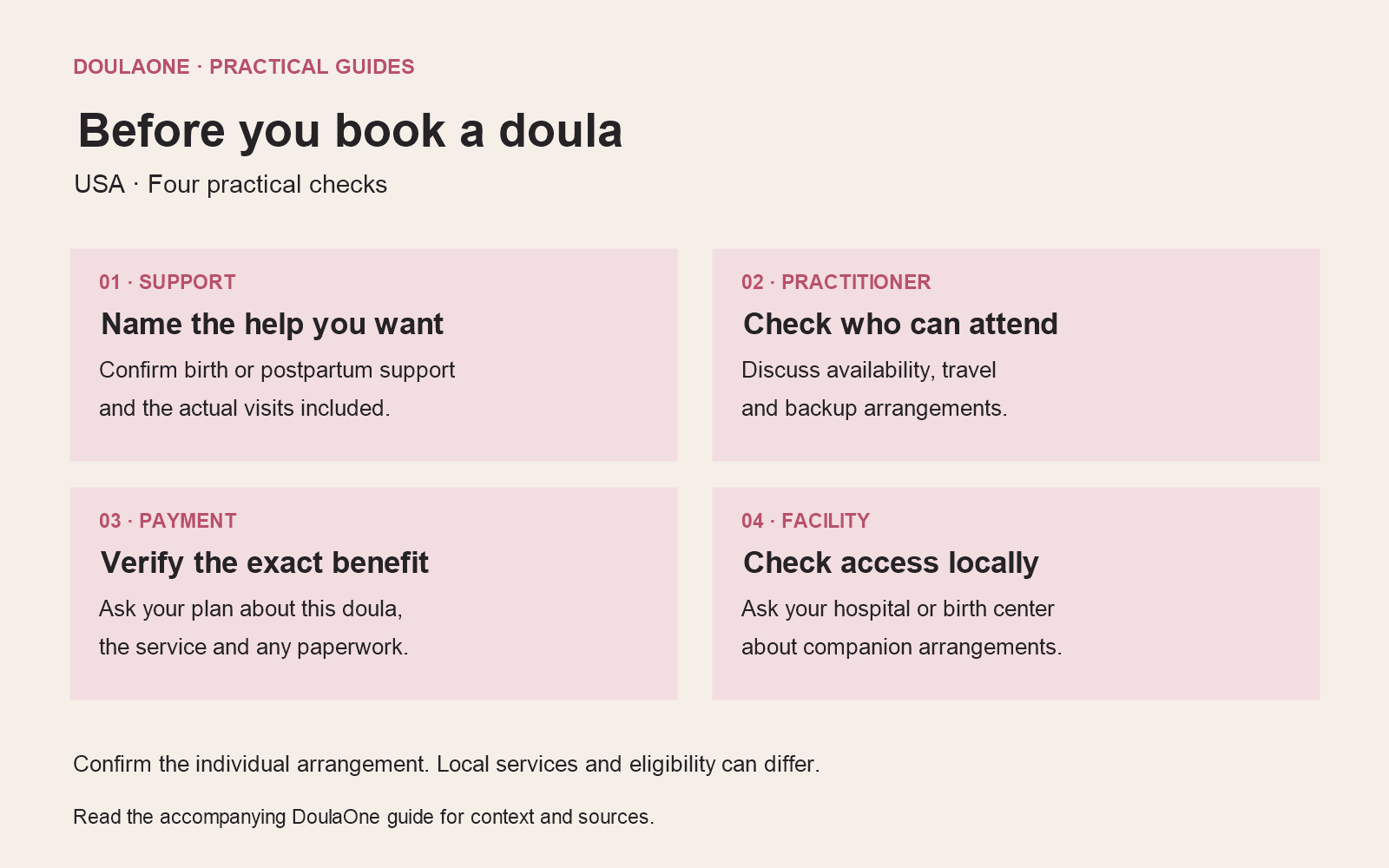
Turn a promising conversation into a clear arrangement
Before committing, ask who will attend, when the doula is on call and what happens if they are unavailable. Discuss travel, overlapping bookings, longer support and the terms if plans change. Ask about training, relevant experience, insurance and how concerns are handled.
For postpartum work, describe an ordinary day and ask what a visit could include. Confirm hours, tasks, rescheduling and the limits of any feeding or newborn-care support. If you need specialist care, ask who would provide it and under what qualification.
Keep your own short note: what is confirmed, what needs checking and what you liked or found difficult about the conversation. You should be able to ask a follow-up without feeling you have already agreed to book.
A doula can be one part of your support network. Hiring one is not a test of how prepared you are, and nobody can promise a particular birth. Begin with the help you value, then check that the service, payment route and practical arrangements match it.