hiring a doulaantenatal preparationcommunicationdoula agreementuk
You've booked a doula: what to agree before the birth
Turn your booking into clear arrangements for visits, messages, payments and backup. Know what is included and keep maternity contacts separate from doula support.

You have chosen a doula and booked the support. The next step is making the arrangement easy to use: knowing when you will meet, what you can ask between visits and which number to call when you need help.
You do not need to follow somebody else's pregnancy timetable. A booking made early in pregnancy, a later booking and a postnatal-only arrangement will look different. Use this guide to check the details of your own agreement and raise anything that is still unclear.
Keep a copy of what you have booked
Start with the service description and agreement. You should be able to find the included visits, availability dates, fees, payment dates, backup arrangements and what happens if circumstances change. If the conversation and the document say different things, ask for the difference to be resolved in writing.
Ask what birth attendance includes and what limits apply. Check arrangements for a long labour, transfer between settings, illness, an earlier or later birth, or the doula being unavailable. For postnatal work, ask about visit lengths, scheduling and any minimum booking.
Signing a document does not settle whether every term is fair. The Competition and Markets Authority's guidance explains that consumer terms must be fair and transparent; unfair terms cannot simply be relied on. If you are concerned about cancellation charges or refunds, seek consumer advice appropriate to your UK nation and the particular booking. A practice policy is not the full account of your legal rights.
Save the version you agreed, whether you signed electronically or on paper. Choose a readable format that works for you, including assistive technology if needed. There is no benefit in a neatly branded document you cannot comfortably access.
Share useful information at a comfortable pace
Your doula may use a form, a conversation or both to learn about your support needs. Ask why any sensitive information is needed and how it will be used. You can request a conversation about a question before completing it.
Consider practical information such as how to contact you, accessibility needs, the support people you want involved and what helps you communicate. If previous experiences affect how you want to be supported, you can describe the preference without immediately recounting every detail. For example: “Please check before touching me” can be useful on its own.
For information relevant to medical care, speak directly with your maternity team. Telling your doula does not update your clinical records or replace a clinical conversation.
A private link is a method of accessing a form; it is not proof of good information handling. The ICO explains your right to privacy information. Ask what is collected, why, how long it is kept and who receives it. Include any backup practitioner in that discussion. Agree what may be discussed in a shared chat and what you would prefer to communicate separately.
Plan the meetings around their purpose
Ask how many meetings are included, their length and whether they will be in person, online or a mixture. Set dates that suit your stage of pregnancy, availability and priorities. There is no universal rule that a first or second meeting must happen at a particular week.
One meeting might focus on getting to know you and understanding your preferences. Another might involve your chosen supporter, communication and practical arrangements. A later conversation might revisit changes and check the contact plan. These are examples of useful purposes, not a required sequence or an assumption about what you have paid for.
If you book later in pregnancy, ask what can be covered within the time available. If you need breaks, written follow-up, captions or a different meeting format, raise that early. A concise list of the questions most important to you can make a shorter appointment useful.
Agree what messages are for
Ask which channel to use for routine questions, the usual reply timeframe and what happens during leave or another client's birth. Agree how to flag a change in your plans and how to request a longer conversation. Avoid assuming that a read receipt means someone is available to discuss the issue.
For a birth booking, write down the on-call dates and the exact way to contact the doula when you want support. Ask what to do if there is no answer, who provides backup and how that person will receive the necessary information. You can ask whether an introduction is possible before support is needed.
Keep the clinical route distinct. If you think you are in labour or are worried, contact your midwife or maternity unit for guidance. The NHS advises urgent maternity contact if your waters break, you have vaginal bleeding, your baby's movements reduce, or you think labour is starting before 37 weeks. These are examples, not a complete list. Use your maternity service's instructions and do not delay contacting them while waiting for a doula. For a life-threatening emergency, call 999.
Walk through a change of plan
Choose a fictional situation and ask how the arrangement would work. For example: “If I am admitted before your on-call period starts, who should I contact about your support, and what could you offer?” Another useful question is: “If you cannot come, how will I find out who is available and what happens to the fee?”
This is also a chance to discuss induction, a planned caesarean birth or a change in place of birth if relevant to you. Your maternity team explains clinical options and local attendance arrangements. Your doula explains what support they can provide within those circumstances.
You should not have to make a new set of support decisions under pressure because everyone assumed something different. Record any agreed change to the service, cost or availability and keep a copy.
Check payments and practical details
Match the payment schedule to the agreement and save receipts. There is no single deposit or instalment structure that is right for every booking. If you need to discuss affordability or a change in circumstances, raise it as soon as you can and ask for the outcome in writing.
Confirm travel or parking charges, access arrangements for home visits and how to reschedule. If a payment request looks different from what you expected, check with the practitioner through a contact route you already know before paying.
Know what follow-up includes
Ask whether postnatal visits are part of the booking, when you will arrange them and what support they cover. You may want to talk about the birth, get practical help or identify other services. You can also say you are not ready to discuss the birth in detail.
If you would like more support than the agreement includes, ask about availability and costs separately. A birth booking does not automatically include ongoing postnatal care.
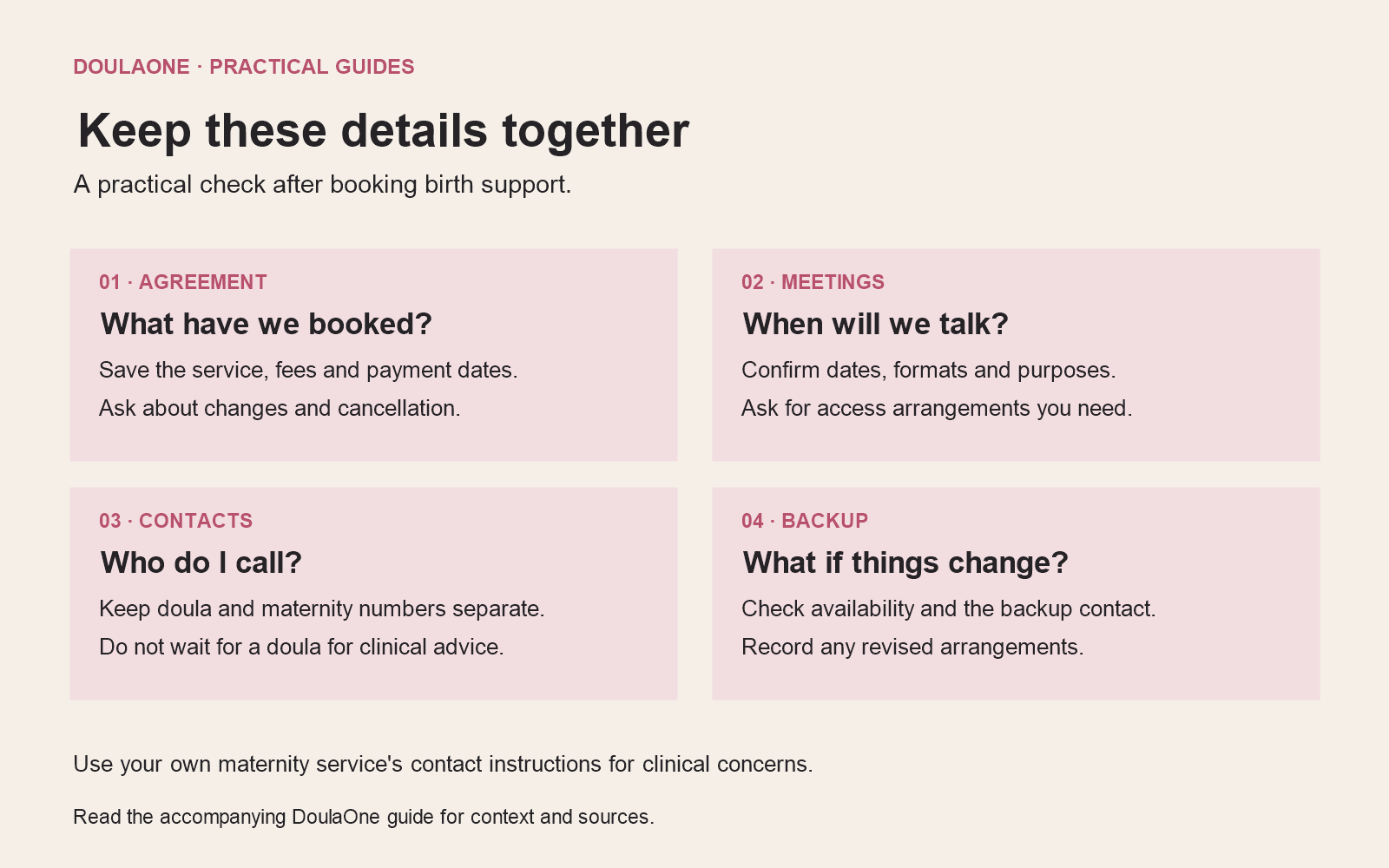
Before your next meeting, bring any unanswered questions from the four-part checklist. Aim to leave with details you can find and use: what is agreed, when you meet, how to reach the right person and what happens if something changes.