doula businessstarting outbusiness setupcontractsuk
Starting a doula business in the UK: before your first booking
Connect your service, costs, contracts, insurance and client records before you launch. UK startup guidance, including a dated Making Tax Digital check.

Your first booking brings the work into focus. Someone is trusting you to turn a description of support into an arrangement they can rely on. Before you say yes, it helps to know what you are offering, how you will deliver it and what happens when circumstances change.
You do not need to build a large business infrastructure before meeting a family. You do need a few decisions that fit together: scope, structure, costs, terms, records and a workable way to communicate.
Use this guide to organise those decisions. The tax and data-protection references are UK-focused; individual service, insurance and contractual arrangements need advice appropriate to your circumstances.
Define the service before buying the tools
Write a plain description of the support you are ready to offer. Distinguish birth support, postnatal visits, overnight work, classes and any additional services. They can involve different skills, demands and insurance questions.
For each service, note the area covered, hours or availability offered, what is included and what you cannot provide. Match the offer to your competence and training. A non-clinical doula role should be described clearly, without implying assessment, diagnosis or medical treatment.
Think through the setting too. Home visits, online sessions and a hired room create different practical questions. Who has access? How will you travel? What are the venue’s requirements? What support or supervision do you need? Check safeguarding and any vetting requirements for your actual activities and location rather than assuming one background-check rule covers every doula role.
Choose a service you can deliver consistently. You can add to it later without promising everything at launch.
Choose a structure and understand the obligations
A sole trader and a limited company are different legal and tax arrangements. GOV.UK explains that a sole trader is personally responsible for business debts, while a limited company is legally separate from its owners and brings its own running and reporting responsibilities. Compare the options through the government’s business setup guide and obtain accounting advice where needed.
Do not choose a structure solely because another practitioner uses it. Consider your other income, whether you work alone, the risks involved and the administration you can maintain. Working alongside someone else also needs clear arrangements about who contracts with the client and who receives payment.
If you operate as a sole trader, you generally need to register for Self Assessment when gross trading income exceeds £1,000 in a tax year, before expenses. There are other reasons to register and exceptions to consider; use HMRC’s sole-trader registration guidance. The registration threshold is not a promise that a particular amount of profit is tax-free in your circumstances.
Keep business income and expenses identifiable from the start. A separate account can make this easier; check the account provider’s permitted use and the requirements of your chosen structure. Keep receipts and records in a process you can maintain, following HMRC’s self-employed record guidance.
A 2026 check: Making Tax Digital
As checked on 27 September 2026, HMRC’s timetable brings eligible sole traders and landlords into Making Tax Digital for Income Tax from 6 April 2026 where qualifying income in 2024–25 exceeded £50,000; from 6 April 2027 for over £30,000 in 2025–26; and from 6 April 2028 for over £20,000 in 2026–27. Qualifying income combines relevant self-employment turnover and property income before expenses, rather than looking only at doula profit. Check eligibility, exemptions and the applicable start date in HMRC’s current guide. Starting a new business does not automatically mean these requirements begin on day one.
Check cover for the work you actually do
Ask an insurer or broker about your precise activities. Describe whether you provide birth support, visits, overnight work, classes or other services, and whether anyone works alongside you. Ask about relevant professional indemnity and public liability cover, exclusions, limits, locations and conditions.
Do not assume a membership benefit covers every activity, or that all policies cost a similar amount. Get the answers in writing and keep the policy documents accessible. Check what happens when you add a service, use a different venue or arrange backup. If driving forms part of your work, check the appropriate vehicle cover too.
Insurance is one part of preparation. You also need a realistic plan for illness, overlapping commitments, travel disruption and work that falls outside your role. Agree backup arrangements before describing them as a feature of your service.
Price the whole commitment
Begin with costs and capacity, then decide what you will charge. Count the time needed for communication, preparation, visits, travel, notes and follow-up, as well as the direct support itself.
For example, a three-hour visit with 45 minutes of total travel and 30 minutes of preparation and administration takes four hours and 15 minutes of your working time. That is an illustrative calculation, not a claim about a typical visit. It shows why dividing the fee only by the hours in the client’s home gives an incomplete picture.
On-call availability creates a different constraint: it can limit other work and personal plans even when you are not attending a birth. Model that capacity separately rather than treating every on-call hour as an hour of hands-on work.
Include business costs such as insurance, training, software, travel and venue hire where relevant. Allow for leave, illness and periods with fewer bookings. Review what remains for your own income and taxes. A price you can sustain needs to make sense alongside the number of bookings you can realistically deliver.
Put the agreement in usable language
The agreement should describe the service, total price, payment dates, availability, contact arrangements and what happens if either party cannot proceed. Include backup and changes to the service where relevant. Provide the required information before the contract is made, not only after payment.
Cancellation rights are not simply whatever a template says. Terms must be fair, and a signed clause can still be unenforceable if it is unfair. Use the CMA’s guidance on fair customer contracts as a starting point and have your actual arrangements reviewed. Online, telephone and some off-premises bookings can raise additional cancellation and information requirements.
A family should be able to ask a question about the terms without feeling that the booking depends on silence. Explain the practical meaning of the agreement and keep an accessible copy of what was agreed.
Prepare for the information families will share
Decide what you need at enquiry, booking and during support. Explain your use of personal information in a privacy notice and set appropriate access, security and retention arrangements. Keep detailed client information out of general marketing tools and public AI services unless you have assessed and authorised the specific processing appropriately.
Health information is special category data. The ICO explains that processing it requires both an Article 6 lawful basis and an Article 9 condition. A service agreement alone does not settle every data-protection question. Work through what you collect and why, including any sharing with backup practitioners.
Check whether you must pay the ICO data-protection fee using its self-assessment tool. Paying the fee, where required, is separate from complying with the wider rules.
Rehearse one booking before taking it live
Use fictional details to walk through the process. Send an enquiry, prepare the reply, issue the correct service information, create an invoice and schedule the first appointment. Check the links and decide where each record belongs. Remove test details when the rehearsal is complete.
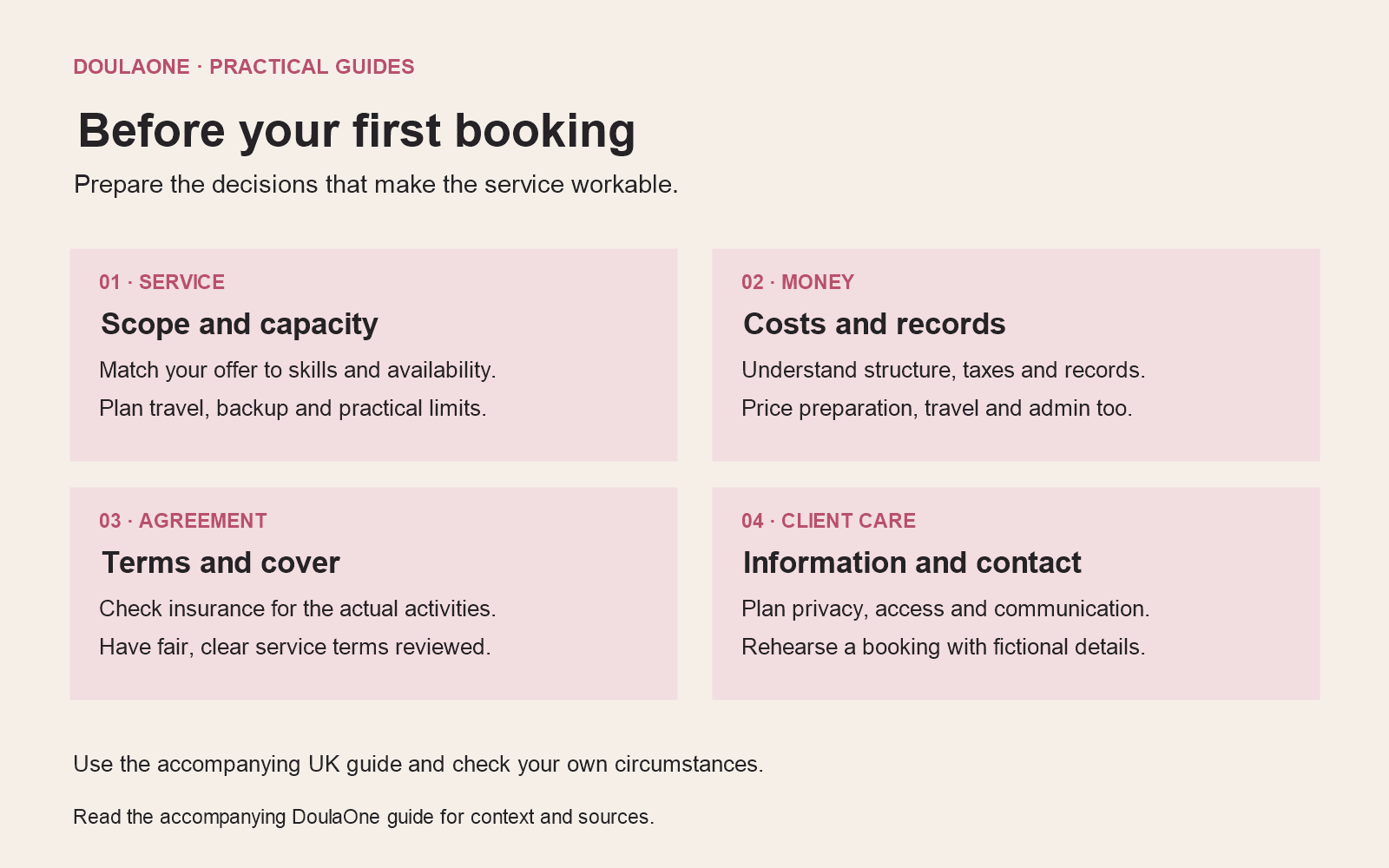
This exercise often reveals a small but important gap: a form that asks too much, a price that differs between documents or an unclear next step. Resolve those before adding more software or services.
DoulaOne’s paid plans include client records, calendars, contracts and invoices; the free directory listing is a separate way to be found. Choose practice tools that support the arrangements you have made, and check any accounting software separately against HMRC’s requirements. A practice-management system is not, by itself, evidence of tax compliance.