doula businesson-callbackup doulasshared careuk
On-call planning for doulas: can you take another booking?
Look beyond due dates before accepting another client. A worked overlap example and four practical checks cover backup, contact, travel and recovery.

An enquiry arrives for a month that already looks busy. The due date sits between two existing bookings, and the family sounds like a good fit. You could say yes. The harder question is what that yes would mean if two people needed you at once.
An on-call plan needs to show more than due dates. It has to account for the availability you have promised, your backup’s commitments, travel, other work and the time you need after a long period of support.
There is no single client limit that makes sense for every independent doula. A shared-care team covering a small area works differently from one practitioner travelling long distances. Use a repeatable booking check instead of a universal number.
Put the promised availability on the calendar
Begin with the dates agreed with each client. A due date is one entry; an on-call window is a period of commitment. Display the whole period, including any planned handover or unavailable dates that form part of the arrangement.
Be precise about what that period means. Does it cover telephone contact, attendance when requested under the agreement, or a shared rota? How should the family reach you? What happens outside the agreed dates? Avoid saying “available whenever you need me” if there are important qualifications that the family only discovers later.
The start and end of the window should match your service, agreement and backup plan. Do not present a particular pregnancy week as a universal doula standard. Nor should a doula’s availability determine when a family seeks assessment or contacts their maternity team.
Add the commitments that are easy to forget: antenatal appointments, postnatal visits, employed work, caring responsibilities, travel and time away. A calendar with empty mornings may still be a calendar you cannot realistically add to.
Work through the overlap, not just the total
Consider this fictional example. The dates are chosen to illustrate planning, not recommended on-call lengths:
Client A: 1–28 June.
Client B: 15 June–12 July.
Proposed client C: 29 June–26 July.
At most, two windows overlap. A simple “no more than two” rule would appear to approve the booking. But accepting C also creates a continuous on-call period from 1 June to 26 July: 56 days without a gap in those commitments.
That changes the conversation. Who covers a day you need off? How do you recover after a long birth? Is your backup also covering their own clients during those weeks? What happens to the postnatal visit already booked for the following morning?
The example does not predict when any baby will arrive. Its purpose is to reveal the promises running at the same time. Even a single booking needs a contingency for your illness or inability to travel.
Before confirming another client, write down one difficult but plausible scenario: two requests for attendance during the same night, followed by an existing morning commitment. Walk through who does what. If the plan depends on someone being “probably free”, it is not ready to promise.
Make backup a specific arrangement
“I know another doula nearby” is a useful connection. A workable backup arrangement goes further. Discuss the actual dates, responsibilities and limits with the person concerned, then make sure the family understands what has been arranged.
Questions worth resolving include:
Which dates and times has the backup explicitly agreed to cover?
What other clients or work could make them unavailable?
Who contacts whom, and how will a handover be confirmed?
What travel area and response expectations are realistic?
Are their competence, insurance and service arrangements suitable for the work?
How are fees, extended attendance and any replacement support handled?
Decide what happens if that backup is also unavailable. This may involve another agreed arrangement, a narrower promise of availability or declining an additional booking. Do not describe an unlimited network if you have only made an informal arrangement with one person.
Where possible, give the family a chance to meet or speak to the person who might attend. Explain that backup is part of how the service works, rather than introducing it for the first time during a difficult call. Put the relevant terms in the agreement and check that they are fair; the CMA’s guidance on customer contracts is a useful starting point for a professional review.
Agree the contact route before it is needed
Write down the number to use, whether to call rather than message for time-sensitive contact, and the agreed next step if you cannot be reached. Test the route. Check signal, charging arrangements and whether your phone’s settings could silence the call.
Keep the family’s maternity contact instructions distinct from yours. A non-clinical doula does not replace the maternity team, assess whether a symptom is safe or act as the gatekeeper for urgent help. Families should follow their clinical team’s advice and use emergency services when needed, without waiting for a doula to respond.
Your own handover needs a contact route too. Decide how you tell the backup that a request is active, how they acknowledge it and how the family is updated. A message sent is not the same as a handover accepted.
Share what the backup needs, with proper access
Prepare a concise handover appropriate to the role: practical contact details, location, the agreed support and relevant preferences. Avoid copying an entire history into a group chat because it is convenient.
The ICO’s data-minimisation guidance says personal information should be sufficient for its purpose, relevant and limited to what is necessary. Decide what needs to be shared, explain your arrangements to the client and use an appropriate secure route. Health information needs additional data-protection consideration; calling someone your backup does not automatically authorise unrestricted access.
Check who can still see information after cover ends. A useful handover process includes reviewing access, as well as granting it.
Include getting home and recovering
A packed bag and a charged phone solve practical problems. They do not solve fatigue. Think through how you will get home, whether you might need somewhere to rest and who can take over an existing commitment if you are no longer fit to fulfil it.
In Great Britain, Highway Code rule 91 advises against starting a journey when tired and calls for journey planning with sufficient breaks. Do not make driving home exhausted the default final step in your service. Plan alternatives that fit your area and circumstances.
Protect recovery time in the diary and agree how cover will work if support runs longer than expected. The right arrangement depends on your circumstances; a fixed break copied from another practitioner is not proof that you are ready to drive or attend another client.
Use four questions before saying yes
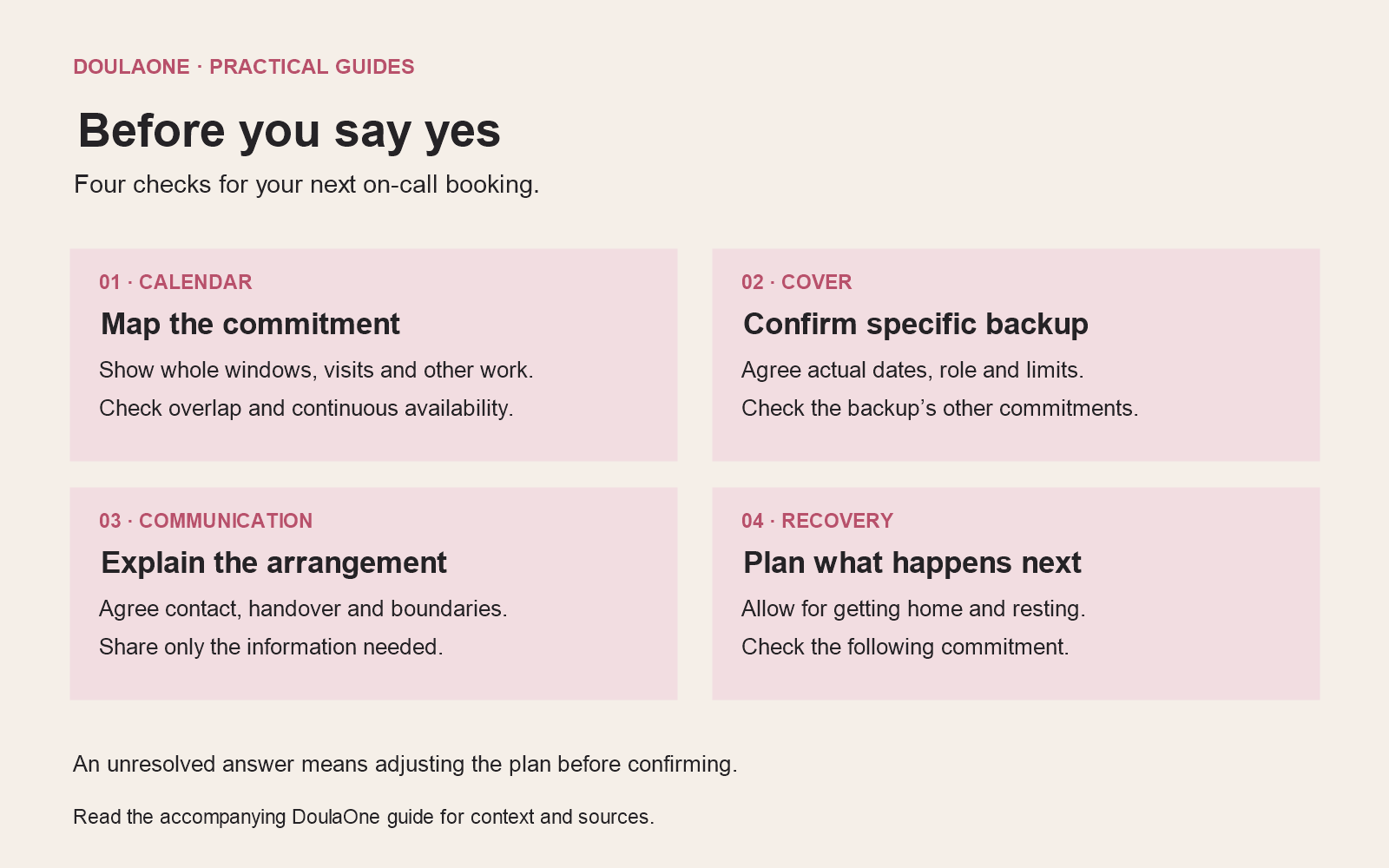
Can I map the commitment? The full availability window and related visits are visible beside my other responsibilities.
Is the cover confirmed? Named people have agreed the actual dates and understand the work, payment and limits.
Does the family understand the arrangement? Contact, backup, handover and boundaries are explained before booking.
Does the plan still work afterwards? Travel home, recovery and the next commitment have a realistic answer.
An unresolved answer is a reason to adjust the offer before confirming it. You might offer a different service, agree shared care, refer the enquiry with permission or explain that you cannot take the booking. That is a practical capacity decision, not a verdict on your commitment to families.
DoulaOne’s practice tools bring calendars and on-call windows together, with shared-care features on Pro. Use that overview to make the commitments visible. The final booking decision still needs the people involved to confirm that the plan works.