doula businessinvoicespaymentscontractsuk
A clear payment process for your doula practice
Clear prices, accurate invoices and respectful reminders can make payments easier to manage. Includes UK cancellation guidance and wording you can adapt.

An overdue invoice can take up more mental space than its place in your accounts suggests. You wonder whether the family has seen it, whether the bank transfer is on its way and how to ask without making the next conversation awkward.
A clearer payment process cannot prevent every delay. It can remove some common sources of confusion: a price agreed in one message, a due date mentioned in another, and an invoice that does not show what has already been paid.
For a UK doula practice, the aim is a process that works for both sides. Families should understand what they are buying and when payment is expected. You should be able to see what is due without reconstructing the agreement from your inbox.
Start with the agreement, before the invoice
Before someone books, explain the total price, what it includes and what could cost extra. Depending on your service, that might mean visit length, travel, parking, additional hours, on-call availability or arrangements for backup support.
Use the same description and figures in your quote, agreement and invoice. If a family chooses a different package, update the documents before asking them to pay. An invoice should confirm the arrangement, not introduce an unexpected condition.
Discuss timing as well as amounts. A birth package, a block of postnatal visits and an occasional appointment may need different schedules. There is no universal deposit percentage or payment week that makes a doula business professional. Choose a schedule that reflects your service and cash-flow needs, explain it in advance and have the terms checked for fairness.
Make instalments easy to distinguish from extra charges. If the total is split over several dates, show the total first, then each amount and date. Avoid phrases such as “balance later” or “before the birth”, which leave room for different interpretations.
A deposit is not automatically yours to keep
The label “non-refundable” does not settle whether money can lawfully be retained. The Competition and Markets Authority explains that cancellation terms must be fair; retention generally needs to reflect the business’s direct loss, and the business should take reasonable steps to reduce that loss. A customer’s signature does not make an unfair term enforceable. See the CMA’s cancellation guidance.
Treat cancellation, a change of service, your own illness and backup arrangements as issues to resolve in your agreement. A refund may be legally required; it is not always a discretionary gesture. A doula package can combine several services and a period of availability, so have a qualified adviser assess how your actual arrangements work rather than copying a generic clause.
Check online and telephone booking rules
For many distance service contracts, consumers have a 14-day cancellation period beginning the day after the contract is made. If services start within that period, an express request and the required information matter. Starting work alone does not remove the cancellation right. Proportionate payment for work supplied may be possible when the conditions are met; full performance has additional acknowledgement requirements.
The government-supported Business Companion distance-sales guide explains the rules and exceptions for England, Scotland and Wales. For Northern Ireland, obtain advice applicable there. Do not assume that a doula service falls within an exemption simply because it relates to pregnancy or birth. This is an area for contract advice on your service, not a tick box to copy from another practice.
Make each invoice understandable on its own
Imagine the recipient opening it on their phone while feeding a baby or between appointments. They should be able to find the amount, due date and payment route without searching earlier messages.
GOV.UK’s invoice requirements include a unique identifier, your business details, the customer’s details, a description, relevant dates, the amounts charged, applicable VAT and the total. Requirements also depend on your business structure and VAT status. Add a clear due date and payment instructions to make the invoice practical to use.
Here is a fictional display example, not a recommended fee or deposit structure:
Package total: £1,200
Already paid: £300
Outstanding balance: £900
This instalment: £450, due 12 October 2026
Remaining instalment: £450, due 9 November 2026
The example separates the amount due now from the full outstanding balance. The £300 is a part-payment; the display makes no claim about whether it could be retained after cancellation. Your invoice and agreement should remain consistent with the actual terms and any legal rights.
Keep service descriptions useful but discreet. A payment document does not need a client’s birth history, clinical information or a detailed account of a difficult appointment. Check the recipient and attachment before sending.
Give reminders a job and a stopping point
Set aside a regular, manageable time to reconcile payments. Mark bank transfers against invoices before sending reminders. Check whether a payment has arrived under a different reference and whether a family has already contacted you about a problem.
A reminder should make the next action obvious. It does not need to sound stern to be clear.
Before the agreed due date:
Hello [name], a reminder that the £[amount] instalment for [service] is due on [date]. Your invoice is available at [link]. If anything on it looks incorrect, please let me know so I can check it. Thank you.
After checking that a payment is still outstanding:
Hello [name], I’m following up on invoice [number] for £[amount], which was due on [date]. I have not yet matched a payment to it. If you have paid, please send the payment date and reference so I can check. If there is a problem with the invoice or timing, please contact me at [contact route].
Use a private contact route and adapt the wording to the circumstances. Do not include sensitive details in a subject line or chase through a public social-media comment. If the family raises a dispute or you agree a new arrangement, pause routine reminders while you deal with it. An automated message should not contradict the conversation you are having.
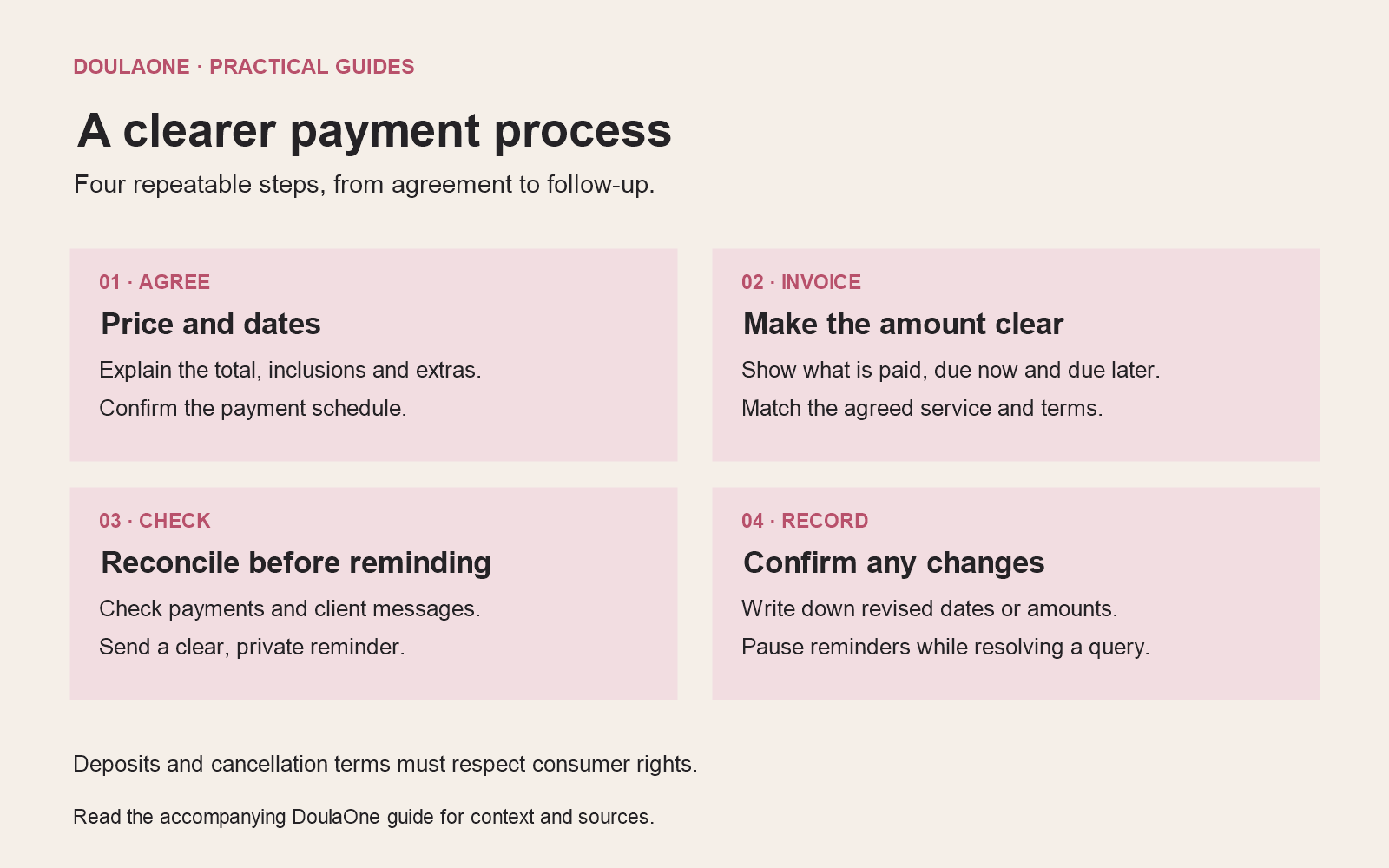
Have a route for problems
Late payment can have several causes. An incorrect invoice, financial difficulty and a disagreement about the service need different responses. Begin by establishing which problem you are dealing with.
If you agree a revised schedule, record the new amounts and dates and confirm them with the client. Keep the original transaction history and use the appropriate accounting correction rather than silently rewriting a paid invoice. Your accountant can advise on the records your business needs.
Do not add a fee, interest charge or payment condition simply because another business uses it. Check that it is lawful, fair and part of the applicable agreement. If a debt remains disputed or unpaid, seek advice before taking formal recovery action. Keep payment administration separate from directing anyone to urgent maternity or emergency help.
You can also decide in advance how much flexibility your business can afford. A limited supported-payment option is easier to manage when its purpose and limits are clear. Offering flexibility does not require making promises you cannot sustain.
Make the process easier to maintain
Before introducing software, make sure the underlying process makes sense: one agreed price, clear dates, accurate invoices and a reliable way to record payments and changes. Then choose tools that help you keep those details together.
DoulaOne’s paid practice plans include invoices and payment tracking; the free directory listing does not. If you are moving from separate documents and messages, start by setting up one service and testing its complete payment journey. Software can help you keep track. Your agreement, judgement and communication still determine how the experience feels to a family.