how-to-get-your-first-doula-clients
How to get your first doula clients without being everywhere
A practical first-month plan for new UK doulas: clarify your offer, build local connections, handle enquiries and ask for reviews without buying praise.

Your training is finished, your website is open and your calendar has space. Now comes the uncomfortable part: helping families find you before you have a long list of former clients to recommend you.
There is no single route that works for every new doula. Your location, availability, community and the support you offer all matter. A useful first month is less about posting constantly and more about making a small number of connections that you can follow through.
Start with a clear offer, a sensible way to enquire and a plan you can repeat. Here is how to put those pieces together without turning every spare hour into marketing.
Make it easy to understand what someone can book
“I support your journey” tells a family very little about the help available. Be specific enough that someone can recognise whether your service fits their circumstances.
Write down the type of support, the area you cover, your current availability and what happens next. For example:
I offer daytime postnatal support in York and nearby villages. Visits can include preparing a meal, helping with everyday household tasks and giving you space to rest while I care for your baby. I currently have Tuesday and Thursday availability. Send an enquiry to arrange a short introductory call.
That is an illustrative description, not a service specification to copy unchanged. Your actual training, competence, insurance and arrangements must match what you promise. A birth doula will also need to explain their on-call period and backup arrangements before a booking is agreed.
Make your fees understandable. If you publish a starting price, explain what changes the total. If you quote individually, explain what information you need and when the family can expect a quote. A family should not have to book a sales call simply to discover that the service is far beyond their budget.
Be equally clear about experience. “Recently trained and working with a mentor” can be a confident, honest statement. Describe the training you have completed accurately; do not imply clinical qualifications or professional registration you do not hold.
Choose two places to be useful
You do not need to maintain a website, five social channels, a newsletter and a weekly event to begin. Choose one place where families can understand your offer and one way to build relevant local relationships.
Your public page is the destination. It might be your own website or a well-completed directory profile. Check it on your phone: can you find the service area, availability, price information and enquiry button without hunting?
Your relationship-building activity should fit your actual community. Possibilities include a local birth-worker gathering, a community organisation that invites practitioners to introduce themselves, or a conversation with someone offering complementary support. Ask how they work and what families commonly need. A connection becomes useful when you understand each other’s boundaries, not simply when someone takes your leaflet.
Avoid implying that a midwife, NHS service, venue or organisation recommends you unless that is explicitly true. Permission to leave a leaflet is not an endorsement. Similarly, being friendly with another practitioner does not mean their clients are yours to contact.
Follow an invitation, not a harvested email list
If a practitioner invites you to send information after meeting, keep the follow-up short and specific:
Lovely to meet you at the community session. As invited, here is the page about my daytime postnatal support, including my service area and current availability. If it would be useful, I’m happy to explain how I handle enquiries outside my scope.
Do not collect addresses from directories and assume that every business email address is fair game. UK electronic marketing rules distinguish corporate subscribers from individuals, including sole traders; marketing to individuals generally needs consent or a valid exception. A publicly displayed address is not, by itself, consent. Read the ICO’s guidance on business-to-business marketing before planning an email campaign.
Keep replies to enquiries separate from newsletter subscriptions. Someone asking about availability has not automatically asked to receive future promotional emails. Avoid unsolicited messages to people because their public posts suggest they are pregnant.
Give enquiries a calm, clear next step
Choose a response window you can maintain alongside your other responsibilities. Put it beside the form and in your acknowledgement. You do not need to suggest constant availability to look professional.
An acknowledgement might say:
Thank you for getting in touch. I usually reply within two working days. I’ll confirm whether I can cover your location and dates, then offer an introductory call if the service looks like a fit. Please do not send detailed medical information through this form.
During the call, help the family understand the service and decide whether they want to proceed. Ask what support they are looking for, explain your role and leave room for their questions. You do not need their full birth history to establish basic availability and fit.
Afterwards, send the information you agreed to send, including the price and next step. If you agree to check back, note the date. Repeated “just following up” messages after silence can become intrusive; one agreed follow-up and a clear way to return later are often a more manageable practice.
Build evidence without buying praise
At the beginning, your evidence may be your training, a clear explanation of your service and how thoughtfully you answer questions. You can also demonstrate your approach with an original guide or a clearly labelled fictional example. Do not invent clients, outcomes or testimonials.
Once someone has used your service, you can invite an honest review without making them feel obliged. Google prohibits incentives such as discounts or free services in exchange for reviews and prohibits selectively soliciting positive reviews. Ask consistently, leave the choice with the client and do not bargain over the wording. See Google’s guidance on getting reviews.
An introductory or reduced fee can serve a legitimate purpose, such as an agreed supported learning arrangement or making a limited number of places more accessible. Set the fee on that basis. Do not make it conditional on a public review, a birth story, photographs or a positive recommendation. Permission to publish someone’s story is a separate decision from paying for their care.
A first-month plan you can actually finish
Use this as an experiment, not a promise of bookings. The numbers are manageable starting points; adapt them to your time and area.
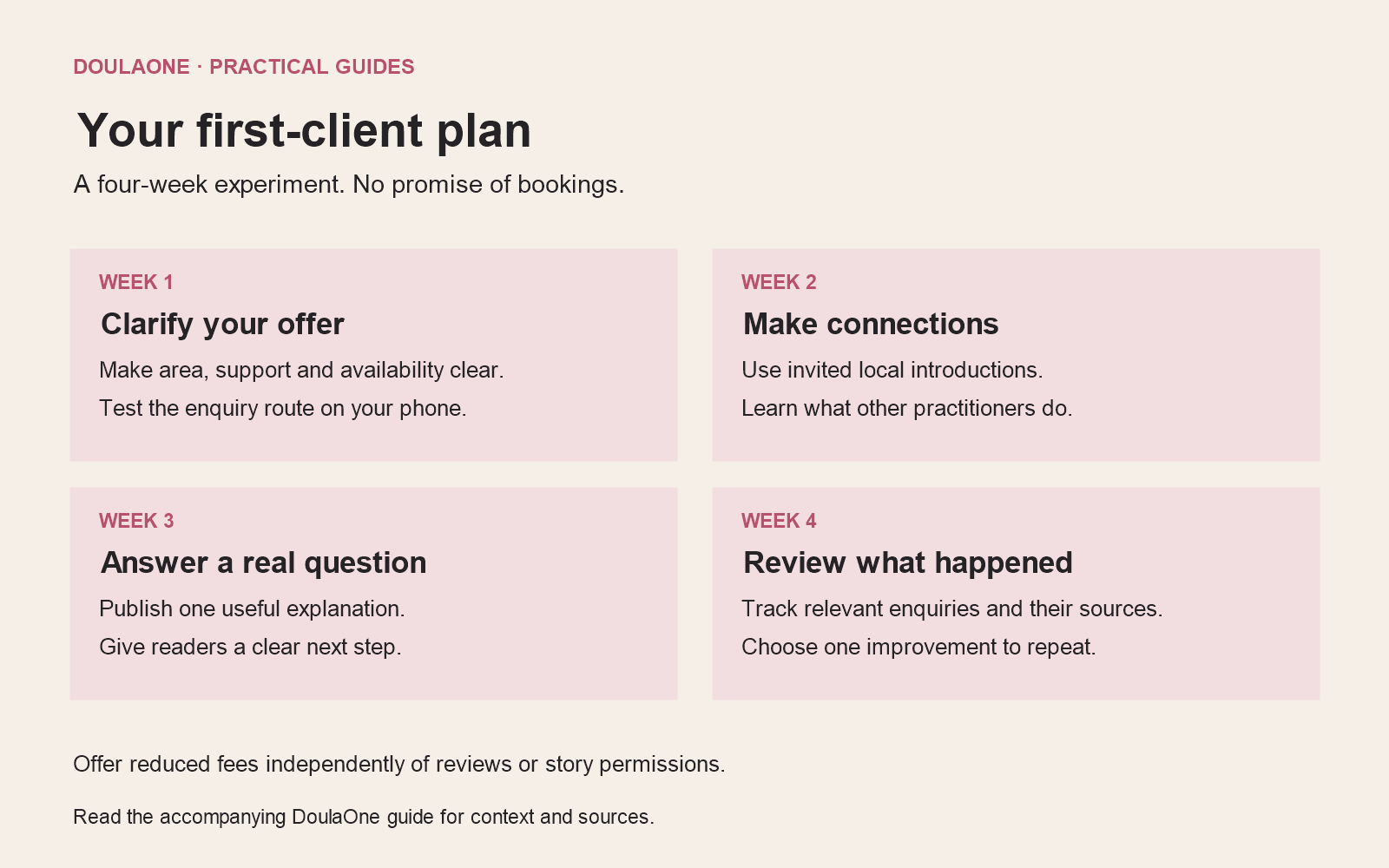
Week one: make the offer clear. Complete one public page. Ask someone unfamiliar with doula work to explain what they think they could book after reading it. Fix the gaps, then test the enquiry form and your reply process.
Week two: make relevant connections. Identify three suitable local organisations, events or practitioners. Use their stated introduction route or attend an event where networking is welcome. Aim for a useful conversation, not an immediate referral.
Week three: answer a real question. Publish one helpful piece that addresses a question families have actually asked, such as what happens during a first postnatal visit. Include your area and an appropriate enquiry link. Avoid turning individual clients’ experiences into content without their permission.
Week four: look at the evidence. Record how many relevant enquiries arrived, where people heard about you, how many conversations took place and what happened next. Small numbers will be noisy. Use them to choose your next improvement, not to declare that one channel always works.
If people visit but do not enquire, check clarity and the contact route. If enquiries consistently fall outside your area or availability, make those details more visible. If the service is a fit but nobody books, consider whether your explanation, timing or offer needs work before assuming your price is wrong.
Give the next family a clear place to find you
Your next useful action may be smaller than launching another channel: complete your service description, reply to an invited introduction or make your enquiry form easier to use.
DoulaOne’s free directory listing includes a public profile and enquiry form. Paid practice tools are separate. Start with a profile that accurately describes your work, then build a repeatable way to respond when the right family gets in touch.