birth partnersdoula supportbirth preferencescommunicationuk
Your doula and birth partner: agreeing the support you want
Plan support around your preferences. Practical prompts for your doula and chosen birth partner, with room to change your mind and clear clinical boundaries.

One person offers to handle the bags. Another asks about breathing techniques. You would like to know who will listen when you want everyone to stop talking. Planning support for birth starts with that question: what helps you feel heard?
Your doula and chosen birth partner can bring different kinds of support, but they do not need a fixed division of jobs. Agree a starting point together, then leave room for your needs to change. You are the person giving birth; supporting you matters more than keeping anyone in a predetermined role.
Start with your preferences
Before arranging a group conversation, think about what you would like others to know. You might feel more comfortable discussing some things privately with your doula or midwife first. You do not owe every supporter the same personal history.
Try completing a few sentences:
When I am overwhelmed, it helps if people…
Before touching me or offering a technique, please…
If I ask for quiet, I would like…
If I find a conversation difficult, help me by…
Information I want kept private includes…
These are prompts, not a test of how well you have prepared. “I don't know yet; please ask me at the time” is a useful answer. You can include the preferences that matter most in your birth plan.
Include the people you actually want
A birth partner might be your partner, a close friend, a parent, a sibling or another trusted person. If you are giving birth without a personal companion, discuss how you want the doula involved and what backup is available. The conversation can work with two people or several; it does not depend on a conventional couple.
Where you plan to give birth may have different arrangements for labour, theatre, recovery and postnatal areas. Ask your maternity service who can accompany you in each setting, and revisit this if plans change. Your preferred support arrangement should be discussed early, including any disability or communication needs.
If someone wants to attend but you do not want them there, you can tell your maternity team. A supporter being enthusiastic does not oblige you to include them in an intimate experience.
Make a flexible first plan
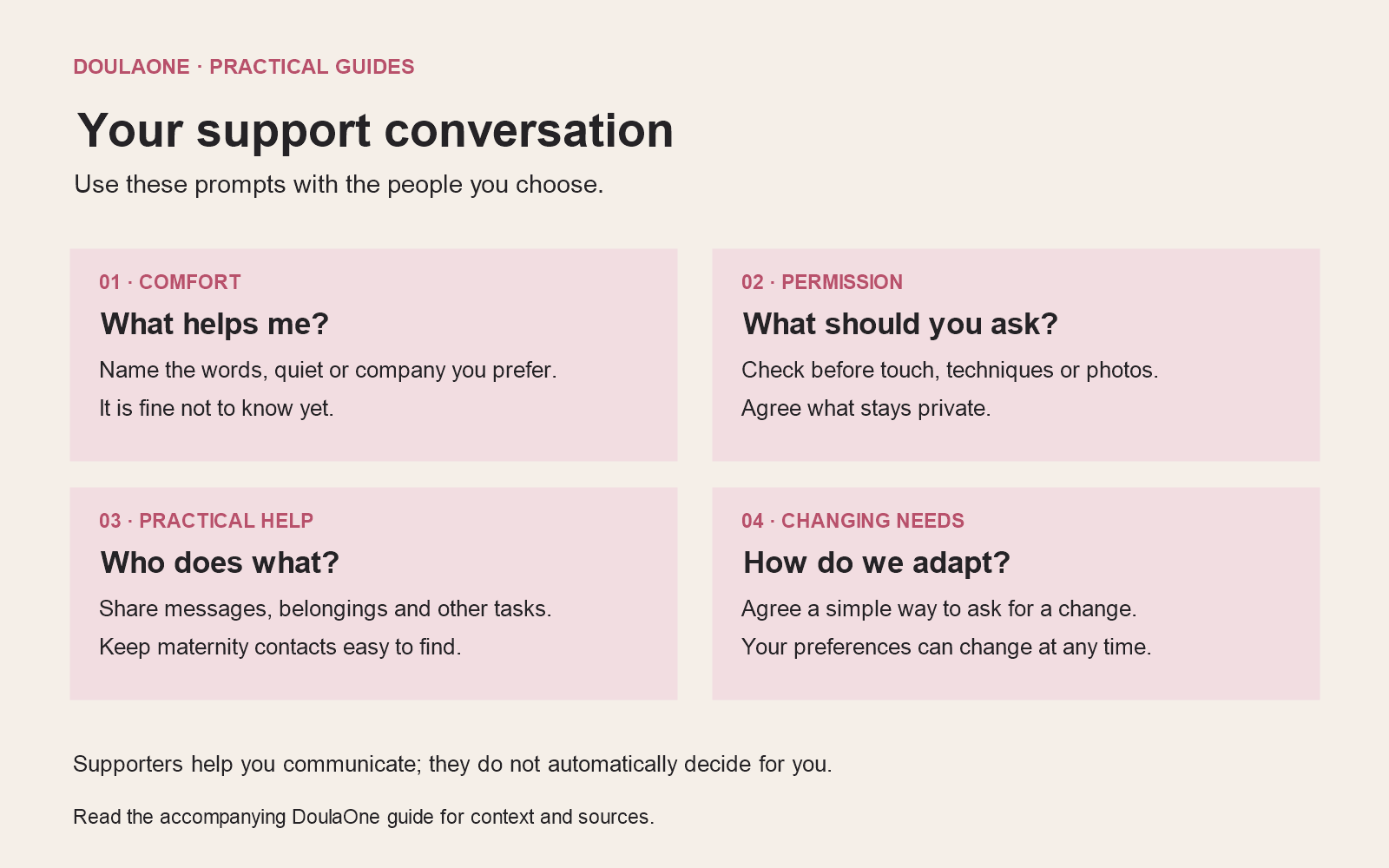
Use an antenatal meeting to discuss what each person is comfortable offering. Start with practical tasks that can be handed over easily: finding belongings, contacting an agreed person, helping you remember a question or getting a chair moved with staff guidance.
For comfort, ask rather than assume. You might want your partner's hand and the doula's quiet presence. You might prefer the doula to offer suggestions while your friend manages messages. You might want neither person touching you. There is no hierarchy of closeness that proves the arrangement is working.
Here is a fictional example to adapt:
“Sam will keep my phone and only update my sister if I ask. Alex, our doula, will help me remember the questions I have written down. Both will check before suggesting touch. If I ask for a different arrangement, we will change it without making it a discussion about anyone's feelings.”
Talk about breaks too. A supporter needing food, fresh air or a moment to regroup can say so. Agree how they will check with you and the other people present before stepping away. Avoid promising uninterrupted attendance by any one person without discussing the practical limits.
Help with communication without taking over
A useful supporter can help you put a question into words, remind others of a preference you have shared or ask for an explanation to be repeated. They can also notice when you want to speak for yourself and make space for that.
For example: “Would you like me to ask them to explain that again?” gives you a choice. “We have decided you aren't doing that” takes the conversation away from you.
The NHS explains that consent must be voluntary and informed. An adult who has capacity makes their own treatment decisions, including whether to decline. A partner or doula does not automatically gain authority to consent for you because you are tired, quiet or in labour. If capacity is a concern, the clinical team must use the applicable legal framework; arrange any relevant discussions with them in advance. Legal arrangements differ across UK nations.
Your doula can support communication about a clinical recommendation, but the clinical explanation and assessment come from your maternity team. Asking how urgent a decision is may help you understand the situation; a supporter should not promise there is always time to delay care.
Keep clinical contacts separate
Agree one clear route for contacting your doula about support and keep your maternity service's number easy to find. A doula's availability is not a substitute for maternity triage.
If you think labour has started or are worried, contact your midwife or maternity unit for guidance. Do not wait for a doula to reply or decide whether you need assessment. The NHS signs-of-labour guide explains when to seek advice. Follow the contact instructions given by your own maternity service.
Your partner or doula can help you make a call, gather what you need or explain your preferences. Agree those practical roles without asking either person to judge clinical safety.
When what you want changes
You may ask someone to come closer, step back, stop a technique or leave the room. That is information about your needs at that moment. It does not mean your partner has failed or that hiring the doula was a mistake.
Choose a simple way to communicate changes: “quiet now”, “please ask first”, or a gesture you have discussed. Tell supporters that a short request does not need a lengthy explanation. If a disagreement develops between them, they should avoid making you manage it during labour and seek appropriate help from staff where needed.
After the birth, you may want company, practical help, privacy or a combination. Ask people to check rather than assuming everyone should either stay close or disappear. Plan separately for who may share news or photographs and with whom.
Return to the conversation afterwards
At a follow-up visit, you can talk about which parts of the support helped and what you need now. A partner may also want space to reflect, while respecting your privacy. Ask how separate conversations and confidential information will be handled.
If someone needs clinical or mental-health support, a discussion with the doula can help identify a next step, but is not a substitute for appropriate care. You do not have to tell the whole birth story before asking for help.
Bring the four prompts above to your next meeting. The useful outcome is a shared understanding of how to listen to you, what each person can offer and how to change the arrangement when you ask.