client notesuk gdprdoula businesspractice management
Client notes for UK doulas: what to record, share and retain
Keep useful client records without collecting a whole life story. A UK guide to note-taking, privacy, backup handovers, access requests and retention.

It is 11pm. You have been home from a birth for an hour, your phone contains three messages you need to follow up, and you are trying to remember exactly what the family asked for before you left.
Useful notes make the next conversation easier. They can help you keep an agreement, arrange a handover and explain what support you provided. But collecting every detail of someone's birth creates its own problems. You need a record with a purpose, a sensible place to keep it and a plan for what happens to it later.
For an independent UK doula, that starts with a small set of decisions you can make before the next booking.
Decide what the record is for
Write down the purpose of each kind of information you keep. Appointment details help you deliver a service. A note of an agreed follow-up helps you do what you promised. An invoice supports your accounts. Those purposes do not require identical information or identical retention periods.
The ICO's data-minimisation guidance says personal data should be sufficient for its purpose, relevant and limited to what is necessary. Apply that to your intake form as well as your notes. If you cannot explain how an answer will affect your work, reconsider the question.
A useful exercise is to open your blank intake form and finish this sentence beside each field: “I need this because…” A medical-history box that invites a life story deserves particular scrutiny. Sometimes a narrower question about an accommodation the client needs will serve your purpose better.
Resolve the privacy questions before collecting health details
Information about a person's health receives extra protection. For special-category data, you need both a lawful basis under Article 6 of the UK GDPR and a relevant condition under Article 9. Some conditions also involve additional requirements under the Data Protection Act 2018. An ordinary service contract does not, by itself, settle both questions. The ICO explains these special-category requirements.
Do not assume that a condition available to a regulated healthcare professional automatically applies to your doula practice. Explicit consent may be relevant, but you need to understand its requirements and what withdrawal would mean. Check your proposed approach with a suitably qualified adviser if you are unsure; the ICO sets out the available conditions.
Put your decisions into an understandable privacy notice. A client should not have to guess why you collect information, who may receive it or how long you expect to keep it. Treat your form, contract, privacy notice and actual working habits as one system: conflicting promises create avoidable confusion.
Record what you know, and how you know it
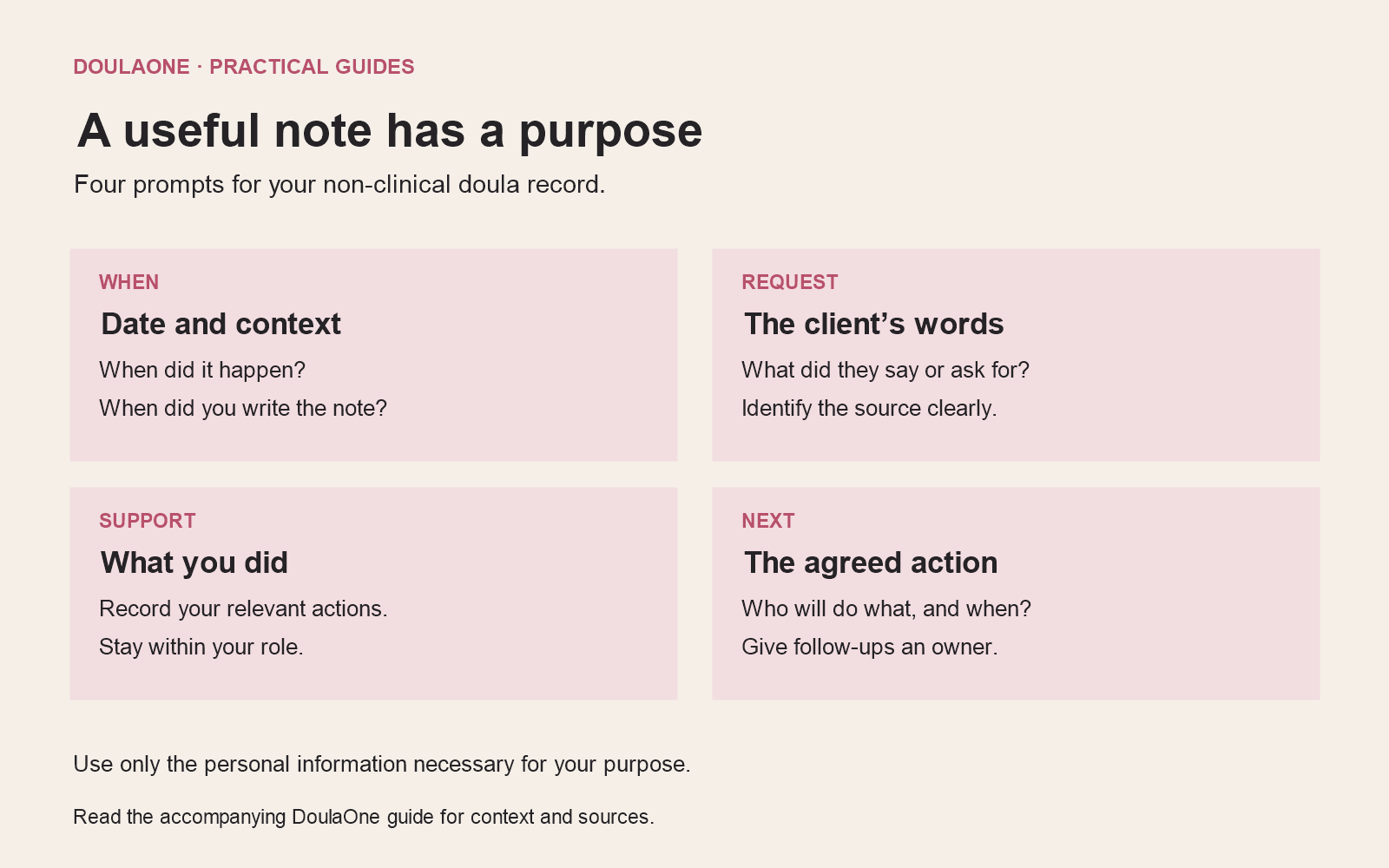
Aim for a short, useful account of your support. Our suggested structure is:
When: the event or conversation date, and when you wrote the entry.
What the client said or requested: attribute it to them.
What you did: practical or emotional support, information shared and agreed actions.
What happens next: who is doing what, and when you will check back.
For example, a fictional postnatal entry might read:
27 September, 10.30am home visit; entered at 1pm. Client said afternoon visitors felt tiring and asked for help wording a message. We drafted a request for visitors to check before coming. Client chose to send it themselves. Agreed that I will check in on Tuesday about the next visit time.
That tells a future reader something useful without speculating about the client's personality. Compare it with “Client anxious and not coping with family”, which turns an impression into an apparent assessment.
Label opinions as opinions and distinguish what you witnessed from what someone reported. The ICO's accuracy guidance makes that distinction important. If you correct an entry, use a dated correction or amendment that preserves a clear account of what changed.
Write within your professional role. A doula note is not a substitute for a midwife's clinical record. If you also hold a clinical qualification, make clear which role you were acting in and follow the requirements that apply to that role.
Make note-taking fit the support
Before attending a birth, explain that you may make brief notes about your work and agree a practical approach with the client. You might record an agreed action during a pause and write a fuller entry afterwards. If a time is approximate, say so; do not turn a later recollection into a supposedly exact timeline.
You do not need an audio recording to create a useful note. Recording a room can capture staff, partners and intensely personal information beyond your purpose. Treat any proposed recording as a separate privacy decision, rather than a convenient default.
The same applies to AI transcription and summaries. Our recommended default is to keep identifiable client notes out of general-purpose AI tools. Use invented examples to improve your template. Before introducing a service that processes real client information, assess its terms, data handling, access, retention and your legal responsibilities. Removing a name alone may leave a family recognisable.
Share a handover deliberately
A backup doula may need the agreed support arrangements, relevant preferences and how to contact the family. That does not mean they need the client's entire history.
Prepare a short handover for the actual assignment. Check the recipient and the sharing settings, explain the arrangement to the client, and record what you shared and why. Avoid putting confidential details in a group chat simply because it already exists.
Keep practical security habits boring and consistent: individual accounts, strong authentication, locked devices, restricted access and a recovery plan. Include paper notebooks and downloaded copies in that plan. The ICO provides security advice for small organisations.
“Private” does not mean outside access rights
A private workspace setting describes who can normally see something in an app. It does not remove a client's data-protection rights.
Personal information in your working notes may fall within a subject access request. A person does not have to use that phrase or fill in your preferred form. Equally, responding is not simply forwarding an unreviewed folder containing other people's information. Check the scope, identity where necessary, applicable exemptions and third-party information, using the ICO's small-business SAR guidance.
Keep a simple process for recognising and handling requests. Practising with a fictional client is a useful way to discover whether you can actually locate the records you hold.
Set retention periods you can explain
There is no universal UK GDPR rule that every doula note must be kept for seven years. The ICO's storage-limitation guidance requires you to justify retention by purpose, taking relevant obligations and needs into account.
Ask your insurer what its terms require, obtain advice about relevant legal obligations and claims, and distinguish client-support records from accounting documents. Do not copy an NHS records schedule and assume it fits an independent doula business.
Document the record category, retention trigger, period, reason and review date. Then put the review in your calendar. Consider backups and exported files as well as the main app, and avoid routine deletion where a complaint, claim or other preservation obligation needs assessment.
Improve one part of your workflow this week
Choose your intake form, your note template or your backup handover. Test it with a fictional family from first enquiry to closeout. Can you explain every field, find the record and follow the deletion plan?
If you are comparing tools for this work, explore DoulaOne. Bring those questions to the comparison. Software can help you organise a practice; the decisions about what to collect, share and retain still need to be yours.
UK practice guide. Sources checked 27 September 2026. This is general information, not individual legal advice; check the requirements of your own practice.